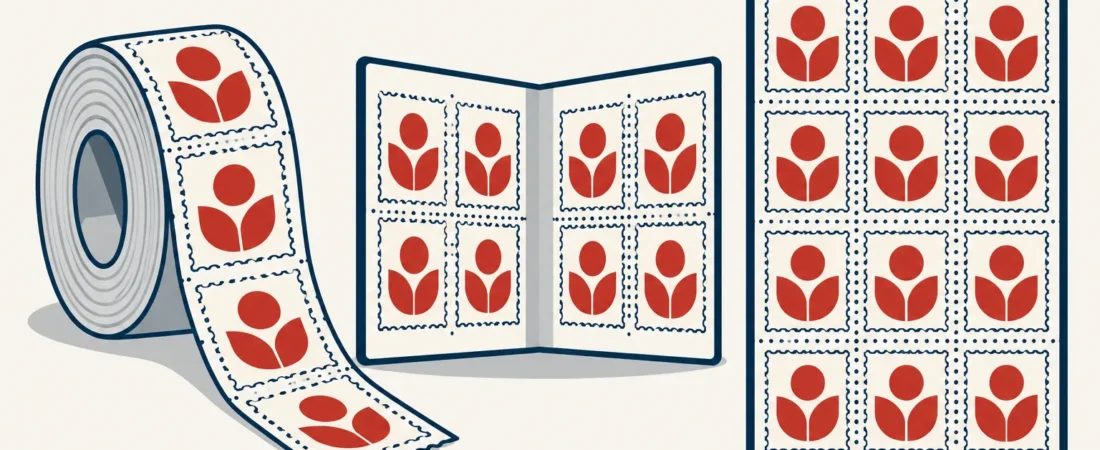
Short answer: Choose a stamp format by matching the package size and dispensing method to the way your team actually mails. Coils support repeated dispensing, booklets are portable for smaller routines, and sheets or panes make individual designs easy to view and separate. The format does not determine how many stamps a mailpiece needs; weight, dimensions, service, and current postage rules do.
What is the difference between a stamp coil, booklet, and sheet?
USPS describes coils as one-stamp-wide strips sold in rolls, booklets as a portable format commonly used for mail, and panes as the smaller “sheets” cut from a press sheet. Those are packaging formats. They help a buyer organize and dispense stamps, but they do not change the postage value printed on or assigned to a stamp.
| Format | Physical arrangement | Often useful when | Confirm before ordering |
|---|---|---|---|
| Coil or roll | A continuous, one-stamp-wide strip | A team applies stamps repeatedly or uses a compatible dispenser | Roll quantity, dispenser compatibility, design, and postage value |
| Booklet | Small portable panes packaged as a book | Several people need compact quantities at desks or on the move | Stamp count, design, postage value, and storage responsibility |
| Sheet or pane | Stamps arranged in rows on a flat backing | Individual stamps need to be easy to view, count, or separate | Pane quantity, design mix, postage value, and storage space |
Which stamp format works best for recurring office mail?
There is no universal best format. Start with the number of mailpieces in a normal cycle, who applies the stamps, where unused postage is stored, and whether a dispenser is part of the workflow. A coil may reduce handling for repeated runs; booklets can simplify distributed use; panes can make small quantities and designs easier to inspect.
Does a coil mean the mailing qualifies for a bulk-mail discount?
No. Buying stamps in a larger package is different from qualifying for a USPS commercial mailing program. Eligibility depends on the mailing class, preparation, documentation, quantity, and other current USPS requirements. Treat package size as an inventory decision, then verify service and postage separately through current USPS guidance before preparing the mailing.
A five-step business format decision
- Describe the mailing cycle. Record typical pieces per run and runs per month. Keep this as a dated planning assumption, not a promise of future volume.
- Name the users. Decide whether one mailroom, several desks, or a mobile team will hold and apply the stamps.
- Choose the handling method. Note whether the team applies stamps by hand, uses a dispenser, or needs designs visible before use.
- Separate inventory from postage. Select the package format independently from the number and value of stamps required for each mailpiece.
- Set a review point. Recheck the plan when volume, mailpiece characteristics, service needs, product availability, or official postage rules change.
What should a buyer verify on a product listing?
Confirm the exact stamp count, format, design, postage value, current availability, and ordering terms shown on that product page. Do not infer a booklet count from a coil listing or assume every design is sold in every format. USPS itself lists some issues in multiple formats, so the selected product record—not the general design name—should control the purchase review.
Use this guide with PostageGrid
Start with the PostageGrid planning tools to document a quantity assumption. Then review the live shop for current product-specific format, quantity, price, and availability. Teams planning larger or recurring needs can review bulk-order information and prepare a volume-quote request.
Official references and scope
- USPS Publication 225: stamp sizes, shapes, and formats
- USPS Postal Store stamp catalog and format filters
- USPS Business Mail 101: Getting Started
PostageGrid is an independent ecommerce and information website. It is not USPS and does not claim USPS affiliation, endorsement, authorization, or government status. This guide explains a planning process; it does not determine mail eligibility, calculate exact postage, promise inventory, or replace the current USPS rules for a specific mailing.