Plan recurring office postage quantities from dated mailing counts, not a single remembered number. Separate forecast, approved, received, and issued states; keep changed-insert or unknown pieces outside the standard batch; and recheck the finished mailpiece whenever the contents, format, or service changes.
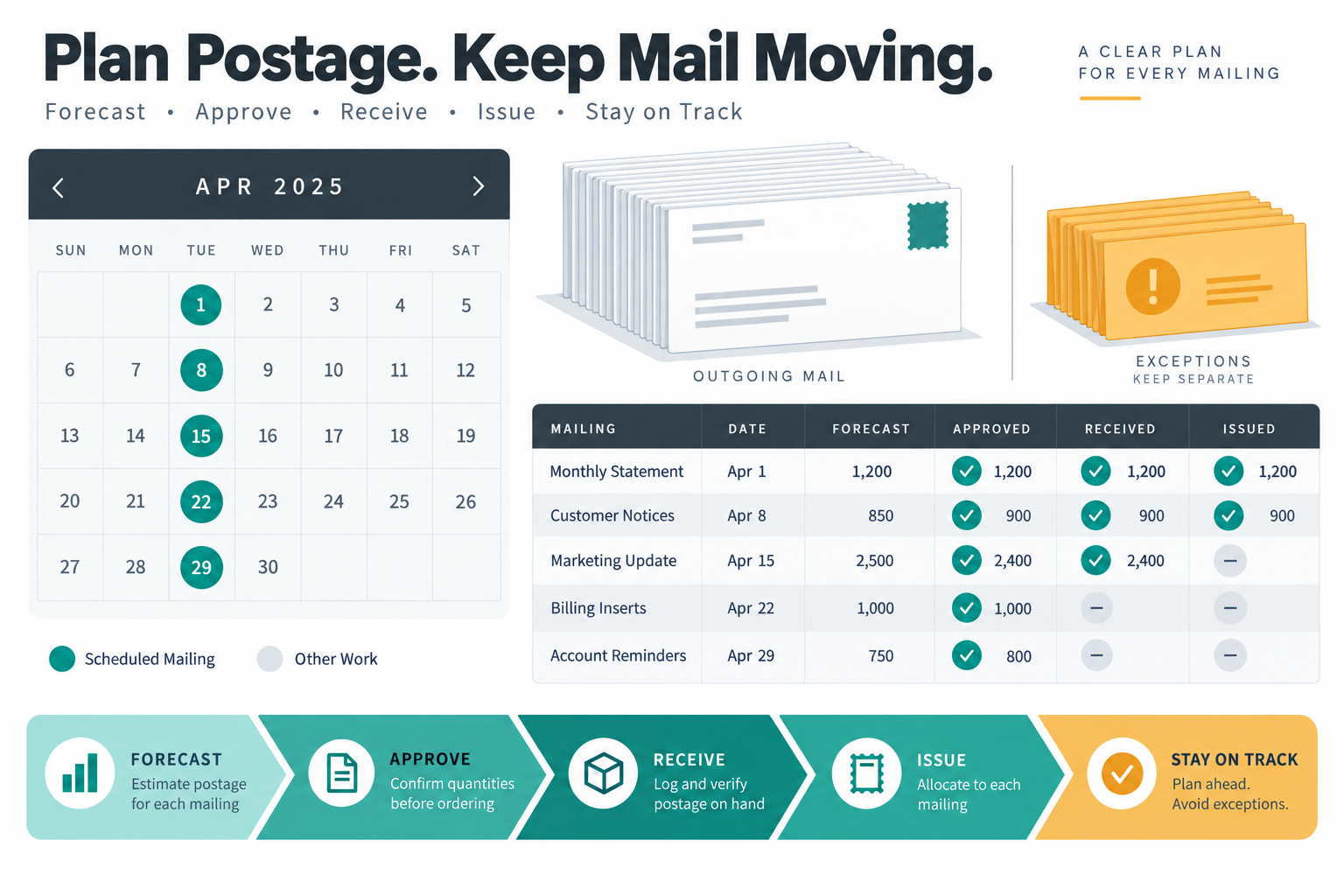
Start with the mailing calendar
List each recurring mailing by program name, planned send window, owner, and count date. “Monthly statements,” “customer notices,” and “membership renewals” are not interchangeable simply because they use similar envelopes. A calendar makes the workload visible and prevents a prior campaign total from becoming this month’s assumption.
For a small office that sends one predictable batch, a dated worksheet may be enough. For a team running several programs, use one line per mailing and one owner for the next count. The owner does not have to be the person applying postage, but the handoff should identify who can explain the number.
Separate four quantity states
| State | Meaning | Release decision |
|---|---|---|
| Forecast | Expected pieces based on the current program plan | Useful for planning, not a final order |
| Approved | Quantity authorized for the next step | Connect it to an owner and date |
| Received | Usable postage or supplies physically checked in | Reconcile before general storage |
| Issued | Postage released to a named mailing or preparer | Keep the program and date visible |
These states answer different questions. A forecast can change when the address list changes. An approval can be held when the finished-piece profile is unknown. A received count can be lower than the approved request because of a split delivery. An issued count can be lower than received because stock remains in custody. Combining all four into one “quantity” column makes the next review harder.
The USPS Business Mail 101 checklist for mailers also separates decisions such as creating the mailpiece, checking addresses, choosing a postage payment method, getting supplies, sorting mail, and completing a postage statement. Use that sequence as a planning frame, then verify the current details for the actual mailing.
Count usable pieces, not just names on a list
A mailing count should state what it counts. Is it the number of address records, the number of finished envelopes, or the number of pieces that passed a quality check? Those can differ. A list may contain duplicates, unresolved addresses, removed customers, or records that receive a different insert.
For a 1,200-piece renewal program, record the list version or count date, the number held for address review, and any subgroup that receives an extra page. Do not add a vague reserve to every program simply because a prior mailing needed one. If the business has a reserve policy, name the policy and show it separately from the usable count.
When the count is still uncertain, write UNKNOWN and assign the next check. That is operationally useful because it tells the approver why the quantity is not ready. A precise-looking number without a source is harder to correct than a visible open question.
Match quantity planning to the finished mailpiece
Quantity and postage are related but not identical. The quantity says how many pieces the office expects to prepare. The postage decision depends on the finished piece’s class, size, shape, weight, thickness, destination, and service. A different insert can create a new subgroup even when the mailing program has the same name.
Build one control sample for each material subgroup. For ordinary letters, that may be a sealed sample with the normal insert. For a statement that sometimes includes a disclosure, keep a second sample for the heavier or thicker version. For a postcard, flat, or parcel, use the relevant current USPS standard rather than transferring a letter assumption.
If the office is deciding between physical stamp formats, review the dedicated coils, booklets, and sheets comparison only after the mailpiece and quantity states are clear. If the real decision is stamps versus a meter, use the office payment-method comparison as a separate branch. Format convenience should not hide an unverified postage requirement.
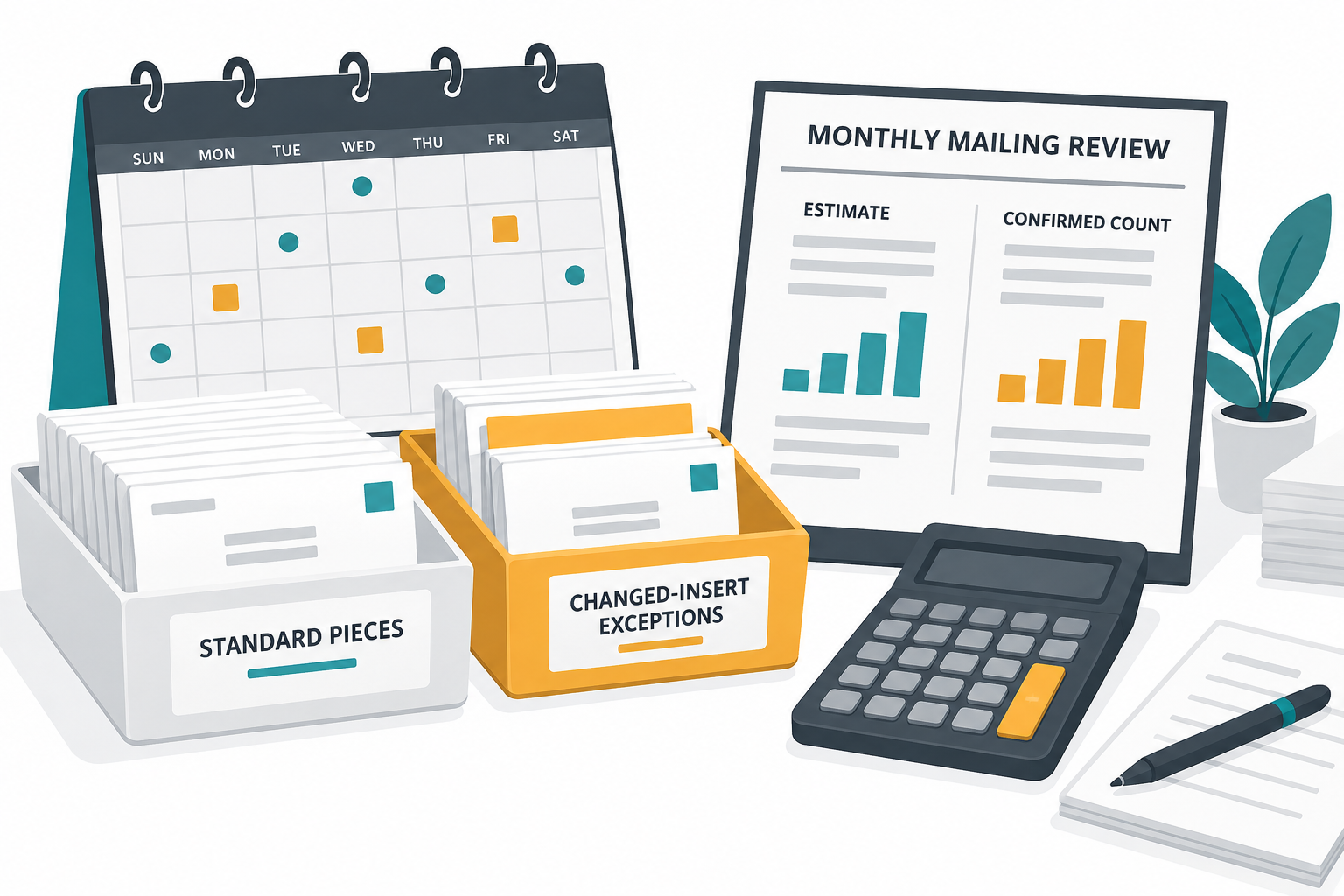
Use a separate path for exceptions
Exceptions deserve their own row or tray when an insert changes, a count is missing, an envelope is damaged, or a piece does not match the control sample. Do not let the majority subgroup absorb the exception just to make the spreadsheet balance.
For a recurring customer-notice program, a practical exception card can record the mailing name, difference from the standard piece, quantity affected, owner, and next check. If the team later confirms that the subgroup shares the same postal treatment, merge it deliberately and keep the decision date. If not, the separate line prevents the wrong stamp or method from being copied into it.
This also helps when a schedule moves. A delayed mailing can remain forecast or approved while the received stock is held for another program. The calendar and state labels make that relationship visible without treating a delivery date as a postal service promise.
Review the plan before ordering or issuing
- Confirm the mailing program, send window, and count date.
- Reconcile the usable count with the address or production source.
- Describe the finished piece and separate any changed subgroup.
- Confirm the current USPS class, payment method, and physical requirements.
- Move the quantity through forecast, approved, received, and issued states.
- Hold unknowns until a named owner supplies the missing evidence.
- Recheck the plan when the insert, address list, rate, format, or service changes.
For a routine office mailing, the approval may be a one-page record. For a multi-department program, connect the count to the person who receives stock and the person who issues it. The office postage custody workflow covers the related handoff after supplies arrive, while the business letter postage readiness checklist helps keep the finished-piece review visible.
Three planning choices for common office situations
| Situation | Planning choice | Why it fits |
|---|---|---|
| One stable weekly batch | Use a dated count and one approved control sample | Low variation makes a compact record practical |
| Several recurring programs | Track each program and state separately | Prevents one mailing’s stock from hiding another’s change |
| Changing inserts or unclear counts | Hold exceptions and plan a new sample | Protects the main batch from an unverified assumption |
The goal is not to predict a perfect number far in advance. It is to make each quantity explainable when the team is ready to approve, receive, or issue postage. USPS rules and prices can change, so confirm current official guidance before a significant mailing. PostageGrid is an independent retailer and mailing-information resource; this article does not claim USPS affiliation, pricing, availability, authorization, delivery timing, or a mailing outcome.
Sources: USPS Business Mail 101 checklist, USPS Business Mail 101 supplies guidance, and USPS Business Mail 101 postage prices overview. Recheck the current USPS materials for the actual mailing.