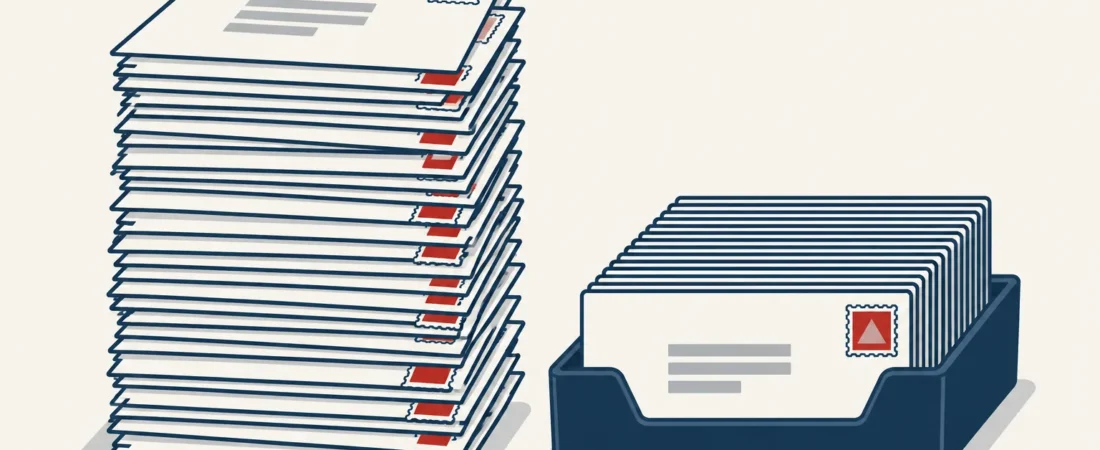
Buying stamps in bulk is a purchasing decision; USPS Marketing Mail is a postal service with eligibility and preparation requirements. A large stamp order does not turn ordinary stamped letters into a commercial-rate mailing.
Start with what you are sending and how you will prepare it. Only then compare postage payment and stamp quantities. This guide helps a small business distinguish the two decisions before it approves a mailing budget.
By the PostageGrid Editorial Team · Postal sources checked October 4, 2026.

What each term means
In retail purchasing, “bulk stamps” describes buying a quantity of stamps for later use. It does not specify the postal class, rate, or preparation of an individual envelope. USPS Marketing Mail, by contrast, covers eligible domestic material such as advertising and newsletters, with a minimum mailing of 200 pieces or 50 pounds. There is no single-piece Marketing Mail price.
| Decision | Question it answers | What it does not establish |
|---|---|---|
| Buy stamps in quantity | How much postage inventory should the office purchase? | Commercial-rate eligibility for the mailing |
| Choose a mail class | Which postal service fits the contents and mailing? | The physical readiness of every piece |
| Prepare commercial mail | Can the team meet the rules for the claimed price? | That any retail stamp order supplies the complete payment method |
| Choose a payment method | How will the eligible mailing’s postage be paid? | That preparation, sorting, or acceptance steps can be skipped |
Check the contents before counting the pieces
The USPS First-Class Mail overview identifies bills, account statements, invoices, and personal or personalized business correspondence among material requiring First-Class Mail or Priority Mail. A large quantity alone does not make these contents eligible for Marketing Mail.
Consider two hypothetical jobs: 300 promotional flyers and 300 customer invoices. The counts match, but the contents raise different service questions. Review the actual documents rather than choosing a postal class from the row count in a spreadsheet.
When a promotional piece includes personal information, check the detailed DMM 243 content standards. Do not assume that a logo or sales paragraph makes every enclosure eligible. Ask USPS about a mixed or uncertain piece before committing to production.
Quantity is a starting check, not the full qualification
A team preparing an advertising campaign may meet the published volume threshold and still have work to do on the mailpiece, address list, sorting, markings, payment, and entry. Determine who will handle those tasks and where the prepared mailing will be accepted.
If you use a mailing provider, request a written description of what its quote covers. Printing, list work, preparation, postage, and delivery to the acceptance facility may be separate charges. A low postage estimate can be misleading when it excludes work your staff must perform.
For a smaller campaign, compare the effort of a commercial mailing with the ordinary stamped-mail process. The useful question is the total cost and feasibility of each suitable option, not simply which advertised postage rate looks lowest.
Build a budget that keeps the decisions separate
| Budget line | What to record |
|---|---|
| Mailing profile | Contents, domestic destination scope, and finished-piece measurements |
| Quantity | Actual recipients after removing duplicates and unresolved addresses |
| Postal option | Service and price basis checked against current requirements |
| Preparation | Printing, folding, addressing, sorting, and staff or provider time |
| Payment and entry | Method, acceptance arrangement, and applicable setup charges |
| Inventory | Stamps needed for confirmed stamped pieces, with existing stock deducted |
For each feasible option, add its fixed costs to its per-piece costs multiplied by the mailing count. Use dated quotes and an explicit postage assumption so another person can review the comparison. This budget structure is an editorial planning tool, not a postal price formula.
Suppose your team expects 300 flyers but has confirmed only 180 usable recipients. Resolve the count before approving the mailing plan. Keep possible future recipients outside the current total, and do not buy extra inventory solely to make a forecast look complete.
Where stamps fit into the final plan
If the mailing will use ordinary stamped correspondence, choose the purchase quantity and format after checking each finished-piece type. Our stamp-format comparison covers handling, while the recurring office quantity guide helps connect purchases to actual usage.
If you are preparing Marketing Mail, confirm its authorized payment and entry arrangements with USPS or your mailing provider. Do not apply ordinary stamps first and expect the mailing to qualify retroactively. Keep the commercial preparation decision ahead of the purchase decision.
Common questions
Do 200 stamped envelopes automatically get Marketing Mail prices?
No. Meeting a count does not establish content eligibility or satisfy preparation and payment requirements. Confirm the intended mailing against the applicable USPS standards.
Is Marketing Mail suitable for customer invoices?
Do not plan on using it for invoices. USPS identifies invoices among material requiring First-Class Mail or Priority Mail. Review the complete contents if you are combining documents.
Can PostageGrid’s volume quote replace USPS qualification?
No. A product quote concerns a retail purchase. Postal eligibility, preparation, and acceptance remain separate decisions to check with USPS.
When you have confirmed a stamped-mail requirement, use our procurement checklist or request a stamp volume quote with the quantity and format you need. Explore the mailing guides for related preparation steps.