A business postage approval record should bring the mailing purpose, dated quantity, finished-piece profile, address review, owners, and open questions into one place. That record lets an office approve the next step without turning an estimate into a promise about price, availability, delivery, or postal eligibility.
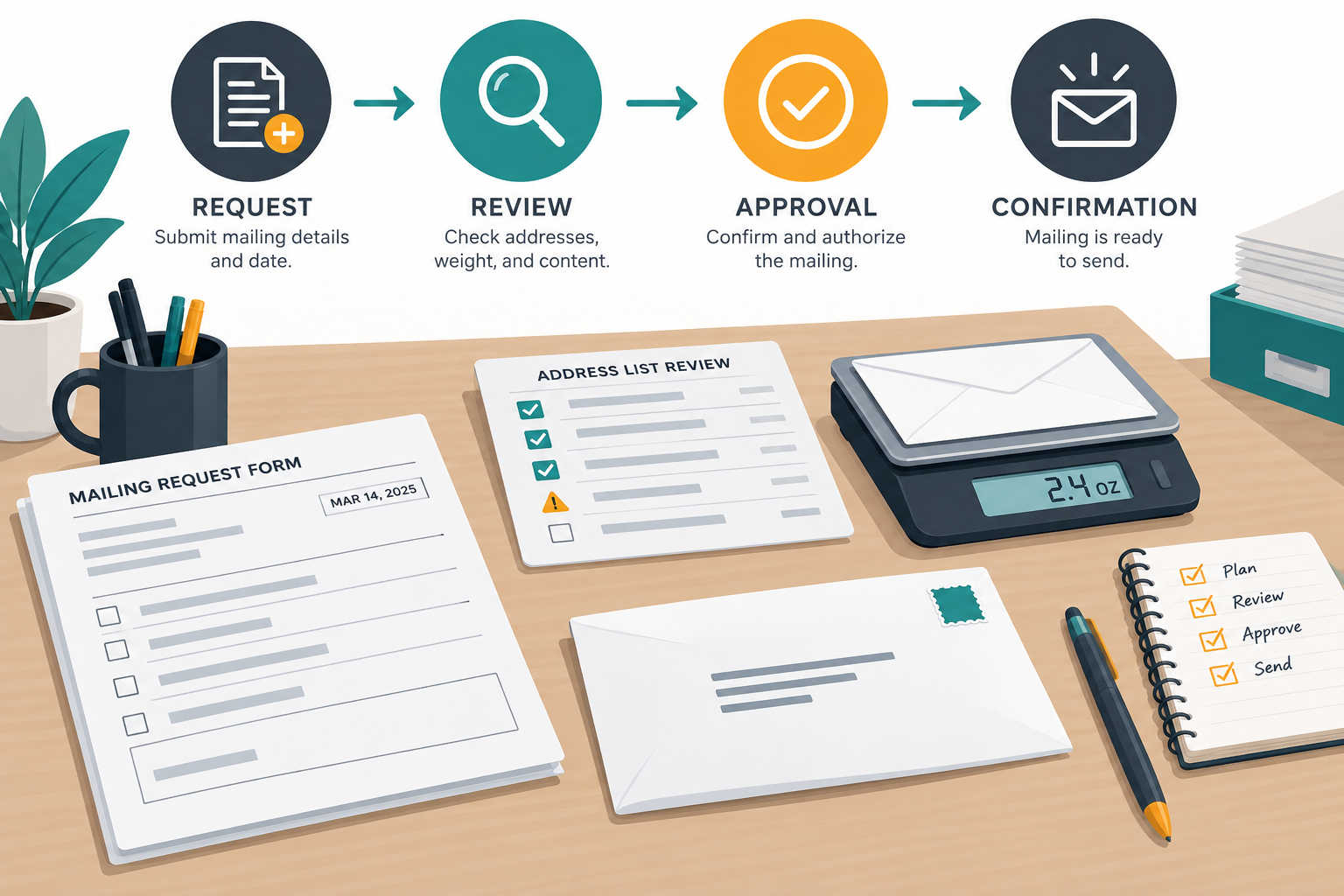
Start with the mailing decision
Write the business purpose, audience, request owner, and target decision date at the top of the record. If a program has several audiences or send windows, give each one its own line. A single total can hide the difference between a recurring statement mailing, a one-time event, and a customer notice.
Record what is known and label what remains open. “Quantity estimate prepared September 19” is useful. “Final quantity” is not useful until the team has confirmed it. Keeping those states separate prevents a draft estimate from being copied into a purchase request as if it were approved.
Describe the finished mailpiece before choosing postage
The approval record should describe the physical piece as far as the team can verify it. Use the finished sample, not an empty envelope or a product description.
| Field | What to record | Why it matters |
|---|---|---|
| Count | Planned pieces and count date | Prevents an old estimate from being reused without review. |
| Shape | Letter, flat, parcel, or unknown | Shape can change the applicable mailing path. |
| Size and thickness | Measured dimensions and units | A visual guess is not a measurement. |
| Weight | Sample or measured finished-piece weight | Inserts and packaging can change the decision. |
| Address data | Source, review date, and unresolved records | The next owner can see what still needs attention. |
| Timing | Desired mailing window and internal cutoff | A business deadline is not a delivery promise. |
USPS Business Mail 101 provides a preparation sequence that includes deciding the mail class, creating the mailpiece, checking the address list, selecting a payment method, preparing the mailing, and confirming where to take it. Use the current USPS Business Mail checklist for the actual class and entry path.
Keep the address review visible
Assign one person to review the address source and record when that review occurred. A standardized ZIP format can help a mailing workflow, but a ZIP lookup does not prove that a person or business is present at the address. Keep address formatting, list ownership, and customer or account validation as separate checks.
For a 600-piece membership renewal, record the list version, the number of exceptions, and the person responsible for resolving them. Do not let an unresolved unit number disappear because the total count looks right. The approval question is whether every exception has an owner and a next action.
Separate estimate, approval, and confirmation
- Estimate: the count, measurements, or timing currently expected.
- Approval: what the budget or mailing owner has authorized for the next step.
- Confirmation: the product, price, availability, and postal requirements checked against the live order, quote, and current USPS guidance.
This three-state record stops a spreadsheet from being read as a purchase order. It also gives a supplier a cleaner starting point when the office needs a business postage volume quote instead of a routine order.
For a small office mailing 80 renewal forms, the approval can be a short dated worksheet. For a recurring statement program, the team should keep the control sample, the approved quantity rule, and the exception process together. A process that works for one small batch may be too thin for a program with changing inserts.
Assign handoffs instead of relying on memory
Name the requester, approver, person who will receive the postage, and record owner. One person may hold several roles. If the request changes after approval, create a new version or write the change and date beside the earlier decision. Do not silently overwrite the prior state.

When the office receives supplies, log the quantity and condition before distributing them. A receiving note connects the approved request to the stock that actually arrived. That connection is useful when multiple employees order supplies or when a recurring mailing is prepared in stages.
If the program uses physical stamps for routine letters, the stamps versus meter comparison can help frame the payment-method discussion. It does not replace classification or live confirmation. If the office needs a custody record after receipt, use the office postage custody workflow.
Close the record with a release question
- Is the count dated and tied to a named mailing program?
- Are shape, dimensions, thickness, and sample weight recorded or marked unknown?
- Has the address source and ZIP-format review been assigned?
- Are unresolved exceptions visible with an owner?
- Is the next action a quote request, a live product review, or another internal check?
- Does the team know which price, availability, and postal requirements still need confirmation?
If any answer is no, hold the handoff and revise the record. A short UNKNOWN is safer than a precise-looking assumption. A good approval record makes the next decision easier because it shows what the team checked, what it did not check, and who owns the gap.
Sources: USPS Business Mail 101 checklist, USPS Business Mail 101 at the Post Office, and USPS Business Mail 101 where to go. Recheck current USPS materials before a mailing decision. PostageGrid is an independent retailer and mailing-information resource. This article does not claim USPS affiliation, endorsement, authorization, product availability, pricing, postal eligibility, delivery timing, or a purchasing outcome.