Quick answer: A stamp print run describes a manufacturing quantity. A pack count tells you how many stamps you are buying. A pane of 20 contains 20 stamps; an announcement saying millions were printed does not change that pane count. For an office order, record the stamps per package and the number of packages separately.
Stamp descriptions can put several numbers next to one another: an issue year, a pane size, a printing quantity, and a seller’s bundle total. Those numbers answer different questions. Keeping them apart makes a purchase request easier to check and prevents an attractive full-pane picture from being mistaken for the entire order.
Four quantities that should stay separate
| Term | What it describes | How to use it |
|---|---|---|
| Print quantity or print run | The number of stamps identified in a production announcement | Read it as issue information, not as the quantity in your shipment. |
| Stamps per pane, booklet, or coil | The number of stamps in that specific package format | Use this as the unit count when the selected listing confirms the format. |
| Packages ordered | The number of those units in your order | Check the selected bundle and cart quantity together. |
| Total stamps ordered | The combined stamp count in the confirmed order | Reconcile it with the package count and any separately listed items. |
A real USPS example: 20 is not 15 million
The USPS announcement for the 2026 Declaration of Independence stamp lists a pane containing 20 stamps and a print quantity of 15,000,000 stamps. Both figures describe the same issue, but at different scales: one is the pane’s contents, and the other is the announced production quantity.
The announcement also gives a plate size of 120 stamps per revolution. That is another production figure. It does not mean a buyer receives 120 stamps when ordering one pane of 20. Reading the field label matters as much as reading the number beside it.
These figures illustrate how to read an official announcement. They do not establish PostageGrid stock, the contents of a particular seller bundle, or the final lifetime production of an issue.
What does “full pane” mean?
USPS describes panes as smaller sheets cut from a press sheet. In a listing, “full pane” should therefore be read alongside the named issue and its stated stamps-per-pane count. It is not a universal synonym for 20 stamps. A different issue may have a different configuration.
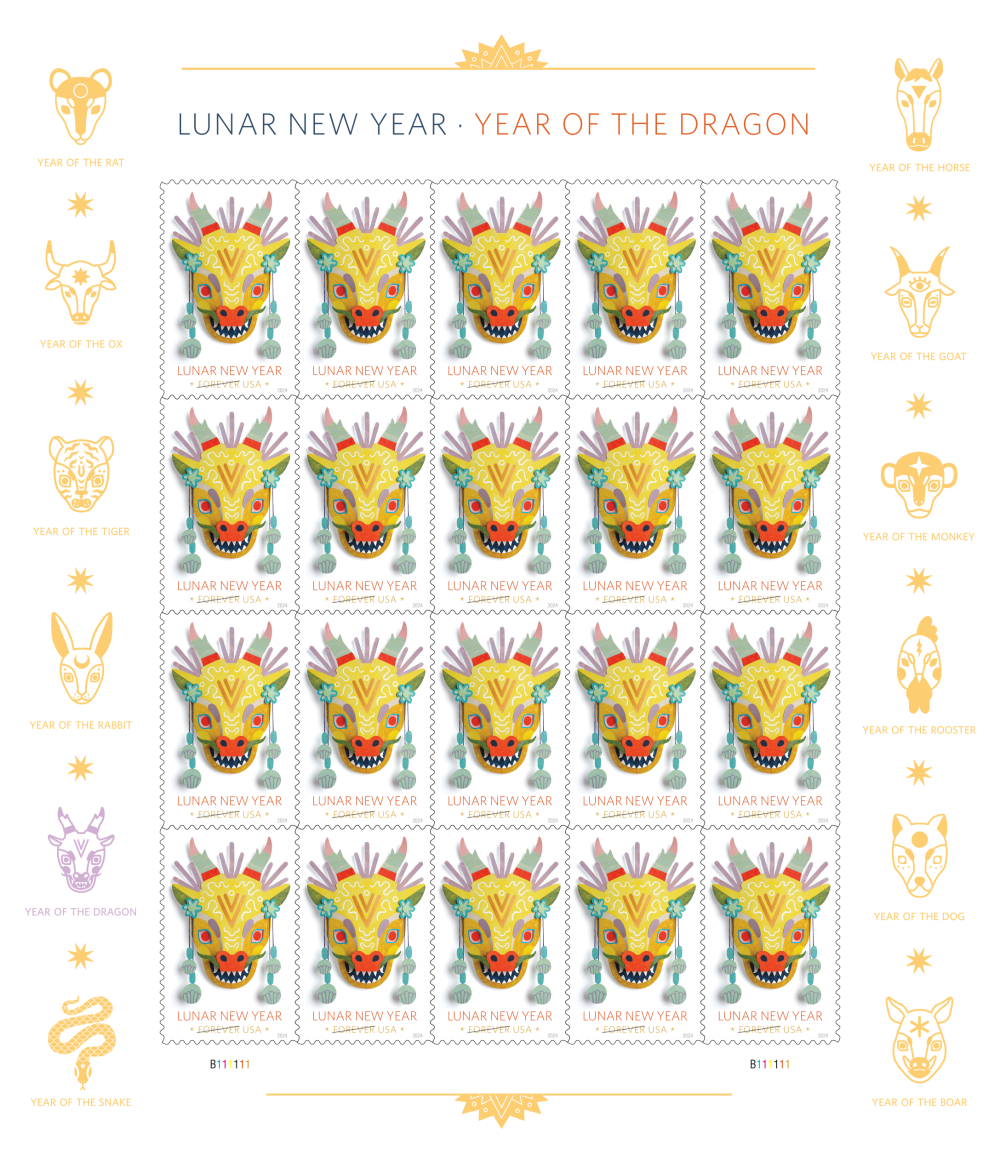
A booklet can also contain 20 stamps without being the same physical format as a flat pane. For dispensing and storage differences, use our coil, booklet, and sheet comparison. Here, the question is how to read the quantities, rather than which format is easiest to handle.
Calculate an order total without changing units
For identical packages, use this simple calculation:
Stamps per package × packages in the selected order = total stamps.
For example, three confirmed panes of 20 contain 60 stamps. Five confirmed panes of 20 contain 100. These are arithmetic examples, not offers or descriptions of every product sold on this site.
Be careful when the seller’s selected unit is already a bundle. If one cart unit is explicitly a bundle of five panes of 20, that cart unit contains 100 stamps. A cart quantity of two then means two bundles, totaling 200 stamps. Do not multiply by five again after you have already converted the bundle into 100 stamps.
For a mixed order, calculate each line separately and add the resulting stamp totals. Keep different postage categories separate as well: the number of stamps alone does not tell you their combined postage value or how many letters they will cover.
Write a purchase request that another person can verify
- Name the selected product and format. Include a link to the actual listing or chosen option.
- Record the unit count. Write “20 stamps per pane,” for example, only when the listing confirms it.
- Record the bundle structure. Distinguish one pane from a bundle containing multiple panes.
- State the total explicitly. Show the calculation so an approver does not have to infer it from a photograph.
- Confirm the live order details. Check the selected cart line before ordering; a catalog announcement is not a stock or shipping commitment.
Use the business postage procurement checklist for the wider review. For a larger request, include the confirmed units and total in your volume-quote request.
What print-run figures cannot tell you
An announced printing quantity does not show how many stamps a seller currently holds. It also does not establish how many remain unused, whether more will be printed, or a future resale price. Keep production information out of an office supply calculation unless you have a separate reason to document it.
Likewise, a coil’s package count is not the number of mailpieces it necessarily pays for. Determine the postage required by each completed mailpiece separately. For recurring work, connect the confirmed supply count to your office postage quantity plan.
Frequently asked questions
Does “pane of 20” mean 20 different designs?
No. It describes the stamp count. The number of designs is a separate issue detail; a pane can repeat a design.
Is a printing quantity the amount available to buy?
No. An announced production figure is not a seller’s live inventory. Check current availability on the selected product page.
Does a picture of one sheet mean I receive one sheet?
Confirm the listing and selected option. The image may illustrate a format while the order contains a different number of those units.
Can I assume all Forever stamp panes contain 20?
No. Confirm the count for the specific issue and format. “Forever” describes a postage category, not one universal package size.
Official sources and review
- USPS Publication 225: stamp formats
- USPS Postal Bulletin: Declaration of Independence stamp production details
- USPS Postal Store: an example of a different sheet count
By the PostageGrid Editorial Team. Reviewed October 6, 2026. PostageGrid is an independent retailer and is not affiliated with USPS.