A stamped return envelope is usually the simplest choice when you expect most recipients to reply. Courtesy Reply Mail works when the recipient can supply postage, while Business Reply Mail lets your organization pay only for pieces that come back but requires USPS setup and per-piece fees. The right choice depends on reply rate, volume, and who should pay.
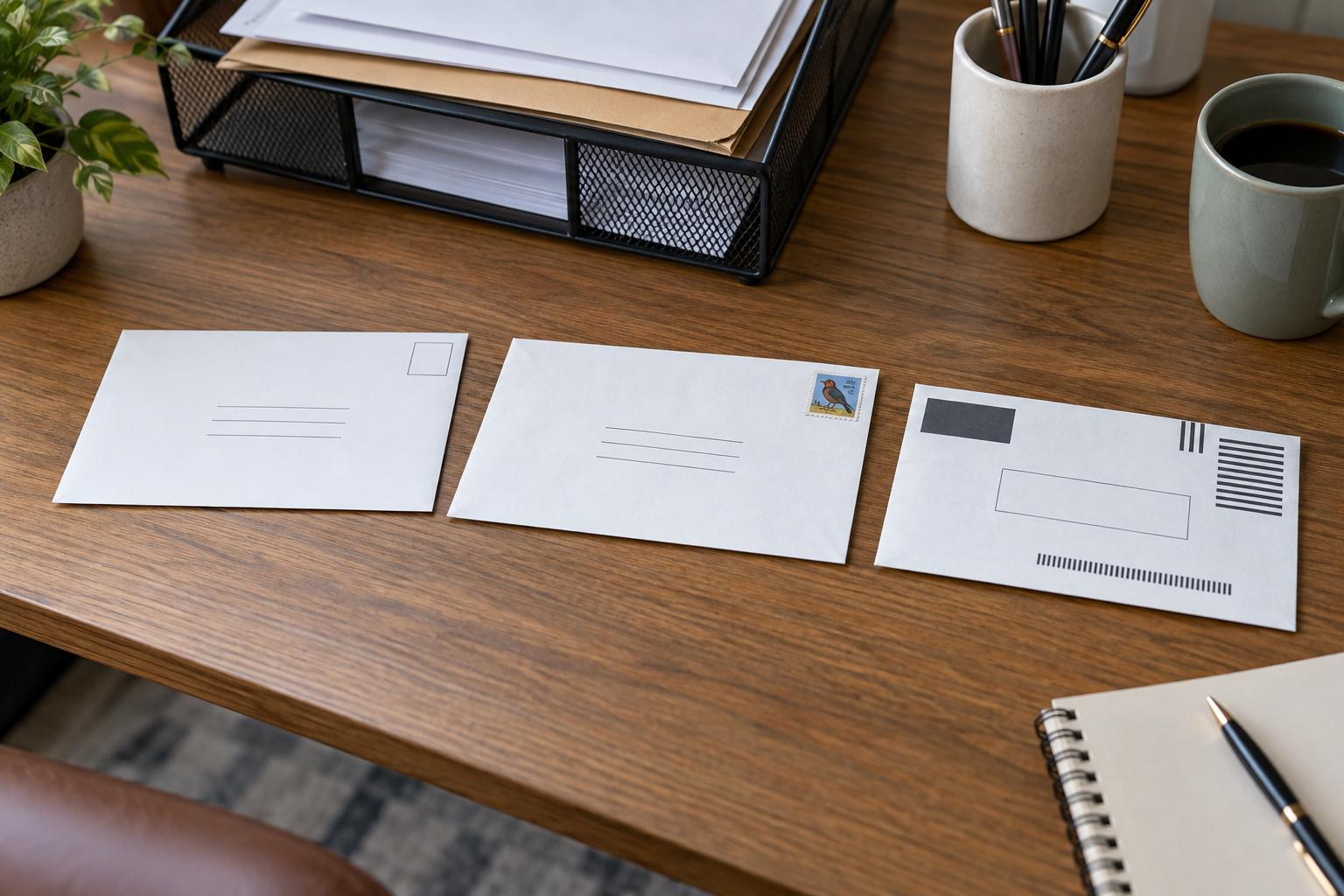
Choose the payment model before you design the envelope
Offices often treat every pre-addressed return envelope as the same thing. USPS rules separate them by who applies postage and who pays when the envelope is returned. That difference changes the workflow more than the envelope artwork does.
| Return option | Who applies postage | When it fits | Main tradeoff |
|---|---|---|---|
| Stamped return envelope | Your office, before insertion | High expected reply rate or a reply you want to make easy | You pay even when the envelope is never returned |
| Courtesy Reply Mail | The recipient | Low-cost routine replies where the sender can provide postage | One more step for the recipient |
| Business Reply Mail | Your organization pays on returned pieces | Campaigns with uncertain response volume | Permit, design rules, postage, and per-piece fees |
For a property office mailing 80 renewal forms with an expected 70 replies, pre-stamping can be easier to administer. For 5,000 survey requests with an uncertain response rate, paying only for returned Business Reply Mail may be more sensible. The decision should follow expected returns, not outbound volume alone.
When a stamped return envelope earns its cost
A stamp removes a small but real task from the recipient. That matters for signed authorizations, nonprofit pledges, membership renewals, and documents with a firm response deadline. It also keeps the return method understandable without requiring the recipient to interpret special markings.
The weak point is unused postage. If 100 stamped envelopes go out and only 20 return, the other 80 stamps are tied to envelopes that may be discarded. For recurring office mail, record the response rate for two or three cycles before deciding that every return piece needs a stamp.
Use one fully assembled reply envelope as the control sample. Confirm its size, weight, flexibility, return address, and postage before preparing the batch. The same readiness check used for an outbound business letter applies to the return piece.
Courtesy Reply Mail keeps the address controlled
Courtesy Reply Mail is a pre-addressed card or envelope supplied by the business, but the respondent applies the postage. USPS guidance distinguishes it from Business Reply Mail because Courtesy Reply Mail does not require a BRM permit or BRM fees. The advantage is address accuracy and faster preparation, not free return postage.
This option works well for low-stakes responses when recipients already expect to pay postage. It is less suitable when a missing stamp could delay an important consent form or payment. In that case, the postage saved by the sender may not be worth the follow-up work.

Business Reply Mail shifts cost toward actual responses
Business Reply Mail allows a permit holder to distribute compliant reply pieces and pay postage plus applicable fees on returned mail. USPS assigns specific design elements, including a unique ZIP+4 or equivalent barcode. It is not a regular envelope with the words “no postage necessary” added by the office.
That makes BRM useful when the number of replies is hard to predict. A company can distribute a large batch without prepaying postage on every insert. Setup and per-piece costs mean a small office should compare the total program cost with simply applying stamps. Consult the local Post Office or USPS Mailpiece Design Analyst before printing a large run.
If the office sends only a steady batch of ordinary letters, compare the workflow with the existing stamps versus postage meter decision. BRM solves a different problem: paying for inbound replies.
A practical decision rule for office mail
Use a stamped return envelope when the response is important and likely. Use Courtesy Reply Mail when accurate addressing matters but the recipient can reasonably provide postage. Investigate Business Reply Mail when distribution is large, response volume is uncertain, and the organization is prepared to manage a permit and USPS-compliant artwork.
Before ordering or printing, run one sample through the entire path: outbound insertion, recipient instructions, return postage, and internal routing after delivery. That test catches the expensive mistake, which is choosing a payment method without checking what happens at the other end.
USPS references: Business Reply Mail and Courtesy Reply Mail. Fees and standards can change, so verify the current USPS materials before production.