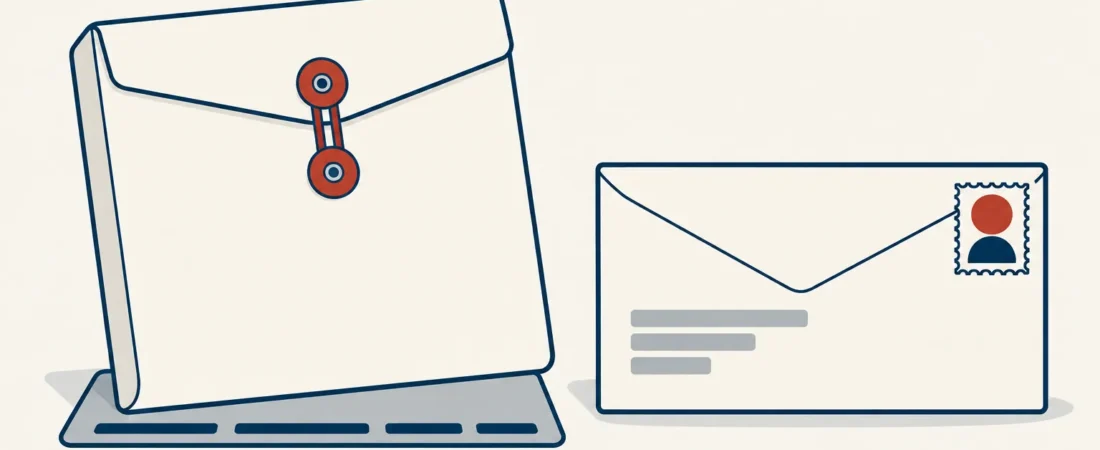
A business letter can need additional postage even when it weighs less than one ounce. Square proportions, rigidity, uneven contents, and certain closures can make a letter nonmachinable. Check the completed envelope before treating your usual stamp as sufficient.
This guide addresses domestic office letters sent at retail prices. It focuses on design decisions that staff can catch before a mailing; it does not certify a mailpiece or replace a USPS classification check.
By the PostageGrid Editorial Team · Postal sources checked October 4, 2026.

Start with the physical piece
The USPS retail physical standards in DMM 101 identify nonmachinable characteristics including an aspect ratio outside 1.3–2.5, certain nonpaper exteriors, closures such as strings or buttons, uneven contents, and excessive rigidity. A square envelope has a ratio of 1.0, so its shape triggers this issue even before weighing it.
Calculate the ratio by dividing length by height, using the address orientation defined in the postal standards. For example, a 6-inch-long by 4-inch-high rectangle has a ratio of 1.5. That arithmetic checks only proportions; it says nothing about its weight, thickness, material, or flexibility.
Keep a ruler and a scale near the mailing desk, but do not let the scale become the only decision tool. A light piece containing a stiff insert can have a different preparation problem from a heavier envelope containing flexible paper.
Look for the feature that changed
| Office mailing | Question to ask | Practical next step |
|---|---|---|
| Square thank-you card | Are its proportions outside the machinable range? | Compare a rectangular format before ordering stationery |
| Card with a rigid insert | How does the completed piece bend? | Present a finished sample to USPS for classification |
| Envelope containing a small object | Does the object make a bulge or move freely? | Review packaging and whether package service is appropriate |
| String or button closure | Does the closure meet the intended service’s standards? | Consider a plain outer envelope and recheck the full piece |
| Paper window envelope | Are other features causing the problem? | Check the finished letter rather than assuming the window is at fault |
A surcharge does not solve every packaging problem
The USPS domestic letter guide recommends padded envelopes or small boxes for rigid and odd-shaped objects. Do not assume that adding a nonmachinable surcharge makes every object safe to send in a paper letter envelope.
A promotional key ring illustrates the distinction. The team’s goal may be to thank a customer, but the object changes the packaging decision. Put an actual sample aside for review before buying stamps for the entire campaign. If the correct result is package service, update the budget and handling plan together.
Likewise, a larger envelope is not automatically a solution. The material and contents can change its processing category. Our separate guide to large business envelopes addresses that decision.
Compare redesign costs before committing
Sometimes a simpler envelope is cheaper to prepare and easier for staff to use. Compare the total cost of the planned piece with a rectangular alternative: stationery, postage, assembly time, and any extra packaging. Keep quoted costs distinct from confirmed postal prices.
Use your own numbers in a short calculation: total batch cost equals the number of pieces multiplied by the per-piece stationery, postage, and assembly cost, plus any fixed setup charge. This is an office budgeting formula, not a USPS rate calculation.
For example, a hypothetical 120-piece client mailing may justify testing two card formats before ordering either. If the rectangular alternative saves time but changes the design, the marketing team can weigh that tradeoff before printing. There is no universal volume at which redesign becomes the better choice.
Confirm the postage after the design is settled
Use the finished piece and current USPS guidance to determine total postage. The USPS postage calculator can help with the applicable service, dimensions, and weight. Ask at the counter when the physical classification is uncertain.
Separate three questions in your record: which mail category applies, whether a nonmachinable charge applies, and which postage payment covers the resulting total. A second Forever stamp may supply more postage value than you need; do not make it your default answer without calculating the amount.
Before releasing the batch, use the finished-letter readiness checklist. Save a dated sample and note its enclosure list so later staff do not apply the decision to a different mailing.
Common questions
Does writing “nonmachinable” change the postage?
A handwritten label does not change the piece’s physical features or pay its required postage. Confirm the classification and payment rather than relying on an instruction written on the envelope.
Is a square card ordinary one-stamp mail?
Do not assume that it is. Square proportions are a nonmachinable issue, and the finished card may introduce other postage factors. Weigh and measure it, then confirm the required total.
Does a window alone cause the surcharge?
No: the retail standards exclude windows in paper envelopes from that particular nonpaper-exterior criterion. Continue checking the rest of the piece.
When your envelope choice is fixed, compare handling formats in our business stamp-format guide. For additional preparation topics, visit all PostageGrid guides.