A large business envelope is not priced by appearance alone. Before applying postage, check its finished length, height, thickness, weight, flexibility, and contents. A document envelope that looks like a flat can be charged differently if it is rigid, uneven, too thick, or outside USPS letter and flat standards.

Measure the finished mailpiece, not the empty envelope
A catalog envelope can change category after a report, binder clip, folder, or return envelope goes inside. Measure and weigh one sealed production sample. Do not estimate from the package label or weigh the paper before assembly.
For a legal office sending a 30-page agreement, the useful test is the exact envelope the client will receive. Add every insert, remove bulky clips that are not essential, seal it, and check whether the contents create a rigid edge or uneven lump. The postage decision belongs after assembly.
Keep the sample with the mailing instructions until the batch is complete. If staff members prepare the envelopes on different days, the sample prevents small changes in inserts from becoming inconsistent postage.
Letter, flat, and package handling are different paths
USPS applies separate physical standards to letter-size mail, large envelopes or flats, and packages. A flat generally needs to remain flexible and uniformly thick. A rigid document mailer may not qualify for flat pricing even when its front dimensions resemble a large envelope.
| Finished piece | Likely preparation path | What to verify |
|---|---|---|
| Standard flexible envelope | Letter standards | Dimensions, weight, machinability |
| Large flexible document envelope | Flat standards | Dimensions, thickness, flexibility, uniformity |
| Rigid or bulky document mailer | Package evaluation | Exact service, weight, dimensions, label |
This is why “How many stamps fit on it?” is the wrong first question. First determine the mailpiece category and required postage. Then choose a payment method that fits the batch.
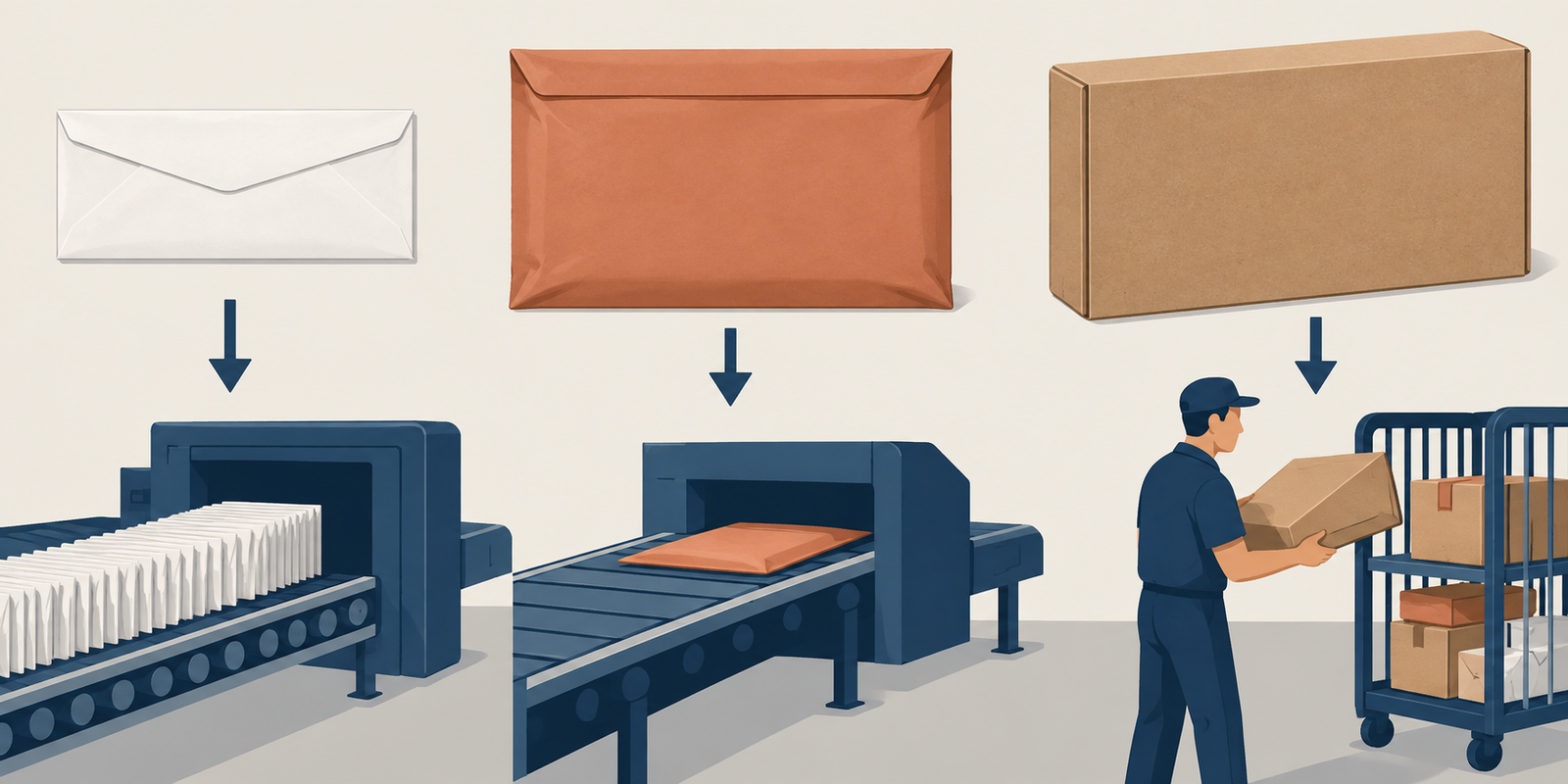
Three office scenarios need three different checks
An accounting team mailing two thin tax-document envelopes can take finished samples to the Post Office and buy exact postage. A benefits department preparing 150 flexible enrollment packets should standardize the insert count and weigh samples from the beginning, middle, and end of the batch. A law firm sending one rigid evidence binder should evaluate it as a package rather than forcing stamps onto a document mailer.
Consistency matters most in the middle scenario. If some packets contain an extra disclosure, split them into a separate batch. One postage assumption should not cover pieces with different weights or thicknesses.
Choose stamps only after the category is confirmed
Physical stamps can work for eligible single-piece mail when their total value covers the required postage. A meter, PC Postage, or a USPS counter transaction may be easier when the amount varies or the piece needs a shipping label. The office should not use multiple Forever stamps as a substitute for determining the correct classification.
For repeatable letter mail, the coil, booklet, and sheet comparison helps choose a stamp format. Large or irregular document mail requires a classification decision first. Format selection comes later.
Use a five-point release check
- Assemble and seal a real sample.
- Measure length, height, and thickness at the thickest point.
- Weigh the complete piece.
- Check flexibility, uniform thickness, and any rigid contents.
- Confirm the current USPS category and postage before preparing the full batch.
Add the confirmed result to the job sheet and keep one control sample. For an office with recurring document mail, this is more reliable than asking staff to remember what was used last month. It also fits naturally into a documented postage custody workflow.
USPS reference: Physical Standards for Commercial Letters and Flats. Current prices and eligibility can change; verify the finished piece with USPS before mailing.
How to mail a large envelope: four checks before it leaves the office
- Measure the finished mailpiece. Seal it, then measure what you are actually mailing. The size printed on the envelope box is not the size of the piece once contents are inside.
- Weigh it. Large envelopes are priced in one-ounce increments, so a 1.3 oz piece is charged as two ounces. An ordinary kitchen scale is accurate enough to keep an office out of trouble.
- Confirm the category. Within the letter limits it is a letter; larger than a letter but within the flat limits it is a large envelope, which USPS calls a flat; beyond the flat limits it is a package.
- Apply the postage, then decide whether you need a mailing record. If the piece is an invoice, a notice or anything a client may dispute, add proof of mailing at the counter.
Letter, large envelope or package: the physical limits
| Category | Minimum size | Maximum size | Maximum thickness |
|---|---|---|---|
| Letter | 3.5″ x 5″ | 6.125″ x 11.5″ | 1/4 inch |
| Large envelope (flat) | Larger than the letter limits | 12″ x 15″ | 3/4 inch |
| Package | Larger than the flat limits | Length plus girth limits apply | — |
Those are the USPS physical standards, and they are why a 9×12 envelope holding a thin catalog stays a large envelope rather than becoming a package. When a mailing is rigid, unusually shaped or sitting right on a boundary, confirm the classification against the current USPS Domestic Mail Manual or ask at the retail counter before printing labels.
Why a nonmachinable surcharge appears on the invoice
Shape, not only weight, decides what a letter costs. A First-Class Mail letter that does not meet the machinable requirements pays an additional per-piece charge on top of the letter price. The usual causes are:
- contents that make the piece rigid or non-bendable;
- a shape that is not rectangular, or a length-to-height ratio outside the accepted range;
- clasps, strings, buttons or similar closures that catch in sorting equipment;
- uneven thickness, for example a pen or a key fob taped inside;
- an address block placed parallel to the shorter edge of the envelope.
Flats work differently: they are priced as automation or nonautomation pieces depending on how they are prepared and how evenly they stack. The practical conclusion is the same either way — check the shape and preparation of the finished piece, not only its weight.
Getting a record that the large envelope was mailed
A Certificate of Mailing (PS Form 3817) is the low-cost way to document that a piece was accepted by USPS. It proves mailing, not delivery, which is usually the right level of evidence when an invoice, a notice or a client file needs a paper trail. If you need delivery evidence instead, compare the services in our Certificate of Mailing vs. Certified Mail guide.
For recurring business mail, pair the record with a simple release routine: the checks in our business letter postage readiness checklist and the postage approval workflow are written for offices that mail in batches.
Choosing the postage for a large envelope
One Forever stamp covers one ounce of First-Class Mail at the letter rate, so a large envelope normally needs more than one stamp, or a meter or printed label at the correct flat price. Use the postage planning tools to estimate cost per piece, and our 2026 First-Class Mail rate analysis for what the current letter rate means at volume. Offices that mail the same piece every week usually find buying stamps in sheets or panes or placing a bulk order cheaper per piece than retail booklets.
Frequently asked questions
Is a 9×12 envelope a large envelope or a package?
It is a large envelope, which USPS calls a flat, as long as it stays within 12″ x 15″ and is no more than 3/4 inch thick. Once it is thicker than that, or above the flat weight limit, it is priced as a package.
Does a large envelope cost more than a regular letter?
Yes. Large envelopes are charged by the ounce from the first ounce at a higher rate than a one-ounce letter, so both the size and the weight of the finished piece matter.
Can I use Forever stamps on a large envelope?
You can, but a single Forever stamp only covers one ounce at the letter rate. A large envelope usually needs more than one stamp, and the exact number depends on the weight and the current large-envelope price.
Do I need a Certificate of Mailing for a large envelope?
Only when you need evidence that the piece was mailed, for invoices, notices or client records. It documents mailing rather than delivery.
Postal prices, weight limits and classifications change. Confirm the current price and the physical standards for your specific piece on USPS.com or at a retail counter before a large mailing.